

Designs
that take you
elsewhere.
Rugier is a contemporary rug house founded in Paris by Manon du Merle and Pierre Jungers. Its collections work as territories, far larger than a range of patterns. Each one begins with a precise reference, an artistic movement, a visual obsession, a tension between forms, sometimes a childhood memory or a travel notebook.
The designs are drawn in France. The rugs are made in Bhadohi, in northern India, hand-tufted in GoodWeave-certified workshops where textile craftsmanship passes from one generation to the next. Rugier works exclusively with New Zealand wool for its resilience and softness, and with Tencel when the concept calls for light.
What the house stands for holds in one simple idea. A rug covers the largest surface in an interior, far beyond the incidental role it is given when slipped under the furniture. It is also the surface people look at most often without seeing it. Rugier gives it back the status of a drawn object.
The twelve rugs presented here read differently according to the hour, the angle and the distance. Some cut into the surface through carving, others catch the light through a blend of fibres. None of them sets out to disappear.
A house
of designers
Manon du Merle and Pierre Jungers come to rugs from other disciplines. She is an interior architect and textile designer, trained at LISAA and then at the École Camondo, with time in an architecture practice on very high-end projects. He is a graphic designer and art director, shaped by the decorative arts and a long practice of image-making.
That gap explains the method. At Rugier, the drawing comes before the technique. A composition is settled first, then translated with the Bhadohi workshop into pile heights, carving passes and fibre blends. Industrial constraint comes second, which gives pieces where the hand is felt twice: in the pattern, then in the execution.
The house speaks to private clients and specifiers alike. Rugier works with interior architects, hotels with character and design studios, for whom bespoke sizes and wool samples are part of the everyday conversation. When a trade client calls Rugier, they speak to the people who designed the rugs.
Rugier is sold direct, on rugiertextiles.com and through trade accounts. Every rug is made to order, which rules out stock, overproduction and end-of-line clearance.
“When you contact Rugier, you speak directly with the people who designed the rugs.”Pierre Jungers, co-founder and art director
The eyes
& the hands

Manon du Merle
Manon du Merle co-founded Rugier with the eye of a textile designer and the craft of an interior architect. Trained at LISAA and then at the École Camondo, she worked in an architecture practice on top-end projects before co-founding Rugier. She likes the contemporary when it vibrates: organic forms, optical illusions, patterns that keep the self-evidence of a thing found as it is.

Pierre Jungers
A graphic designer and art director, Pierre Jungers approaches the rug as a graphic territory. His compositions start from an idea: a homage, a visual reference, a tension between forms. A drawing culture fed by the decorative arts and a long obsession with visual culture.
Both founders draw, and the studio stays open beyond them. The house invites outside designers to take on a whole collection, under the same rule: start from a reference, hold it to the end, and let the Bhadohi workshop find the right technical translation. Highland Grounds came about this way, entrusted to textile designer Alice Wood.
One wool, New Zealand. One workshop, Bhadohi. One certification, GoodWeave. Three standard sizes and bespoke. Five weeks of production. No stock: every rug goes into production after the order.
Manon du Merle
& Pierre Jungers
Hello — could you introduce yourselves?
Manon du Merle: I am an interior architect, a graduate of the École Camondo, and a textile designer trained at LISAA. I have a passion for making, for design, for textiles, patterns and the decorative arts. My work as an interior architect naturally led me to the rug as the centrepiece of a successful interior.
Pierre Jungers: My name is Pierre. I am a graphic designer, a Penninghen graduate, and I spent years in art direction at several Paris agencies. I share with Manon a deep passion for design, furniture and interiors.
We are also a couple, and Rugier was born of that closeness: a house that lets us meet talented people, see beautiful interiors and work on real pieces — dense, beautiful, with substance and a craft dimension. The project took shape quite naturally, as people kept asking us to design rugs for their interiors.
What is Rugier?
Rugier is our house of handmade rugs and, above all, a design brand. We work with designers around us, and with those this project has brought our way, and we want to build a house that lasts — one that gives contemporary design the support it deserves in modern, embodied interiors, with strong pieces that carry an idea, a line of thought, a coherent territory.
Where are your rugs made?
Our rugs are made in India, in the Bhadohi region. We work with several suppliers selected for the quality of their work. All our rugs are GoodWeave certified, an international certification that guarantees the strongest social standards in this industry: no child labour, reintegration programmes, guarantees on working conditions. We work closely with our makers and visit them in India. That closeness is what secures the best materials and the best possible making.
Where do your partner designers come from, and how do you work with them?
We give our partner designers carte blanche, with a single requirement: that something takes us somewhere. A territory, a narrative, a coherent inspiration. Not merely a pattern that decorates and fades into the ambient colours, but a design that carries us into a referenced world. It can be a landscape, the animal world, optical effects, a historic decorative movement, even literary references.
We currently work with Mimo Studio, Marina Taslé d’Héliand, Alice Wood and Hugues Flochel, designers who share this ethic and this command of textile design. In parallel, we develop our own collections. What we ask of everyone is the same: a strong idea, an approach.
And for the collections you create yourselves — where does the inspiration come from?
Our inspirations are often longings accumulated over years, territories we have carried since the beginning of our creative paths. Manon draws on mosaics, geometry, vernacular techniques and natural materials. Pierre returns again and again to postmodern design, to the Memphis movement and the popular graphic languages of the eighties and nineties. These are deep references, not surface quotations.
What does your creative process look like?
We fill notebooks, gather references and build complete moodboards before we start drawing. From there, we develop the designs by hand, through drawing, photographing textures, materials and other sources. We also work more experimentally at times, engineering the optical accident, playing with repetitions that generate visual effects. In every case, nothing is ever gratuitous. We are always trying to communicate something.
An essential dimension of this work is transposition. A rug design cannot be thought of as an illustration or a graphic pattern: tufting and weaving impose their own constraints — minimum detail size, number of colours, scale. We take these constraints on board from the start, and they often help bring about something unexpected, a design that would not have existed otherwise. It is one of the things we find most fertile in this craft.
Once the designs are settled, we pair wool palettes with each motif and work with our suppliers through a series of samples to fix the colours precisely before final production begins.
How many collections do you release each year?
We are launching five collections at our opening, and we plan to add a new one regularly, in spring and in autumn.
What is your vision of this craft?
A rug must belong to its interior. It should not overpower its surroundings — unless, of course, the client wants it to reign. Our role is to bring character, a spirit, an idea, without competing with what surrounds it in visual richness or detail. A rug should be discreet in how it cohabits, and a true tour de force when you stop and truly look at it.
For us, a considered, composed interior cannot do without a rug — at the right size, in a just complementarity of colour with what is already there. It is essential.
Letting others
draw
Rugier entrusts its collections to designers whose world already exists elsewhere: illustration, jewellery, interior architecture, textile design. The house asks them for their subject, the one they already work on elsewhere, and lets it become a rug.

Alice Wood
A French and British textile and graphic designer trained at Central Saint Martins in London, with experience gained inside major fashion houses. Her work explores pared-back forms, naive or geometric, fed by poetry, animals, landscapes and legendary tales. She brings traditional techniques and digital tools into dialogue.

Marie Meilhan-Bordes
A draughtswoman and illustrator trained in the craft of comics at the Académie Delcourt, hence a ligne claire style drawn in one continuous stroke. Simplified figures in minimal settings, an urban and dreamlike world, at times surrealist. Engraving, cut paper and painting complete her practice.

Hugues Flochel
A designer and interior architect trained at the École nationale des beaux-arts and at ESAG Penninghen. He served as creative director at Cartier, where he oversaw the fit-out of every point of sale. His studio HFC has signed jewellery pieces and concepts for Van Cleef & Arpels, Boucheron, Piaget, Richard Mille, Repossi, Chopard.

Mimo
An itinerant studio founded by the interior architects Margaux Padrutt and Raphaëlle Lhuillier, trained at the École Camondo and finalists of the Design Parade 2025. Their practice pairs the discovery of a territory with experiments in local know-how, in a dialogue between the disciplines and the people who make a place.
TODO: set out the schedule of the coming collections for Marie Meilhan-Bordes, Hugues Flochel and Mimo. As it stands, the press will ask why they appear in the kit with no piece to their name.
The hand
shows twice

Hand-tufting means inserting the wool strand by strand into a stretched backing cloth, with a tufting gun guided by hand over a design transferred at 1:1 scale. Nothing is automated: density, evenness and the sharpness of the outlines depend entirely on the gesture.
Then comes the finish. Carving shaves the edges of a pattern to give it a sharp, almost architectural relief. The play of pile heights, from 6 to 20 mm depending on the rug, sculpts the surface and gives it the depth of a bas-relief. On Mainframe, the difference reaches 10 mm and the rug turns from a floor into an object.
Every piece is made in Bhadohi, in northern India, a region where rug-making passes from one generation to the next. The wool comes exclusively from New Zealand, chosen for its resilience and softness. Tencel, a wood-based fibre, comes in when a design calls for light: it catches the light differently and brings out reflections that move with the eye.
- Materials
- New Zealand wool
Tencel (Lyocell) - Technique
- Hand-tufted
Carved or relief finishes - Lead time
- 5 weeks from order
Delivery 1–2 weeks - Production
- Bhadohi, India
Certified GoodWeave
All Rugier rugs are made under GoodWeave certification, which guarantees the absence of child labour and fair working conditions throughout the supply chain in Bhadohi. The certification rests on unannounced inspections of the workshops, including at subcontractors.
No piece is made in advance. Every rug goes into production after confirmation, which removes dormant stock and end-of-line clearance, and allows a size or a palette to be adjusted before the first strand of wool.
Five collections,
twelve models
Dante · Cerdan · Felix
Agata · Gerald · Harlan
El Rojo · Giallo
The Wader · The Stag · The Fox
Mainframe
Each collection starts from a reference held to the end: 1960s op art crossed with the paved floors of Venetian palazzi, the moiré of a silk fabric, the gesture of post-war abstract painting, the bestiary of the Scottish Highlands, the coffer of Haussmann panelling.
Every piece exists in three standard sizes and in bespoke sizes.
Retail prices range from 1 700 € to 3 700 € depending on collection and size. incl. VAT
Each collection is presented with its intention, its rugs and its technical specifications. High-resolution visuals of all the rugs are available on request from the press contact.
Optical Palazzo
L’art optique des années 1960 rencontre les pavements géométriques des palais vénitiens.

The paved floors of Venetian palazzi tell a story of trompe-l’œil: flat-laid tiles that simulate volumes, floor mosaics that hollow out the surface and suggest a relief that does not exist.
Optical Palazzo transposes that tension between the flatness of the material and the illusion of depth. The patterns work on modular repeat, on rhythm, on the alternation of tonal values. Compositions that move without overwhelming the space, and that establish a graphic presence at once strong and quiet.
Hand-tufted in New Zealand wool, with carving passes that give each design the structure and the depth of an architectural floor.

Dante

Cerdan

Felix
- Materials
- New Zealand wool
- Technique
- Hand-tufted
Finition ciselée - Dimensions
- 170 × 240, 200 × 300
250 × 350 cm - Retail prices incl. VAT
- €1,700 to €3,400
Moire
Un seul dessin, lu différemment selon la lumière et l’angle de vue.

The undulating lines of Moire work on a paradox: a fixed pattern that never reads the same way twice. Depending on the palette, the same curves suggest the shimmer of a silk fabric held up to the light, or the compact density of an animal’s coat. The pattern itself stays rigorously identical; the colour decides what you see.
The moiré effect comes as much from the drawing as from the material itself. Tencel yarns are worked into certain areas to intensify the reflections: two fibres, the same pile height, opposite behaviours in the light. The rug changes from morning to evening, seen from the threshold of the room or from its centre.
A presence that moves with the time of day, without ever imposing itself.

Agata

Gerald

Harlan
- Materials
- New Zealand wool
Tencel (Lyocell) - Technique
- Hand-tufted
Sans ciselage - Dimensions
- 170 × 240, 200 × 300
250 × 350 cm - Retail prices incl. VAT
- €1,700 to €3,500
La Pintura
La peinture comme point de départ. Son geste transposé dans la laine, au-delà de son image.

In this collection, the wool becomes pigment and the hand-tufting becomes gesture. The patterns carry an anarchic energy that travels across the surface: something of Soulages in the light trapped by the fibres, of Richter and of Schneider in the way the gesture is allowed to run past the intention.
What is rare here is that the hand is felt twice. First in the pattern, spontaneous and impulsive. Then in the work of rendering it: two pile heights that sculpt the relief and give each piece the depth of a painted surface.
It is like touching a thickly painted canvas. For once, that is not forbidden.

El Rojo

Giallo
Relief léger, sans ciselage
8 to 12 mm
Backing Cotton
- Materials
- New Zealand wool
- Technique
- Hand-tufted
Relief léger, sans ciselage
8 to 12 mm - Dimensions
- 170 × 240, 200 × 300
250 × 350 cm - Retail prices incl. VAT
- €1,850 to €3,700
Highland Grounds
Le bestiaire des Highlands traduit en mosaïque textile, où l’animal devient paysage.

The collection draws its material from the Scottish Highlands: their light, their tall grasses, their mineral expanses. Alice Wood took the colours and the structures of the land and recomposed them into geometric, modular blocks, somewhere between mosaic and pixel.
The fox, the stag and the wading bird appear as quiet presences, barely distinct from the ground that absorbs them. Each rug develops its own palette according to the animal and the landscape it embodies.
Ochres and sandstone for the fox, muted greens for the stag, deep blues for the bird. One graphic language, three readings of the north.

The Wader

The Stag

The Fox
- Materials
- New Zealand wool
- Technique
- Hand-tufted
Hauteur uniforme, sans ciselage - Dimensions
- 170 × 240, 200 × 300
250 × 350 cm - Retail prices incl. VAT
- €1,750 to €3,600
Rugier Special
A single colour, explored in its own depth. Relief as the only pattern.

Rugier Special brings together the pieces that belong to no series: one intention, one design, no variations.
Mainframe explores a single colour in its own depth. Dusty pink holds something of nude and something of beige, a tone that resists any easy name, and that is precisely its strength. Depending on the light, the surface tips towards the warm or the cool without ever settling.
The composition works with repeated square modules set around two large central frames. The pattern is architectural, close to a Haussmann façade or to the coffers of interior panelling. The base surface is tufted at 10 mm, and the raised modules rise to 20 mm with bevelled edges. At this scale and in this material, the rug turns from a floor into an object in its own right.
- Materials
- New Zealand wool
- Technique
- Hand-tufted
Deep relief, carved
10 to 20 mm - Dimensions
- 170 × 240, 200 × 300
250 × 350 cm - Retail prices incl. VAT
- €1,700 to €3,400
Studio Rugier
The first online rug configurator and creator.
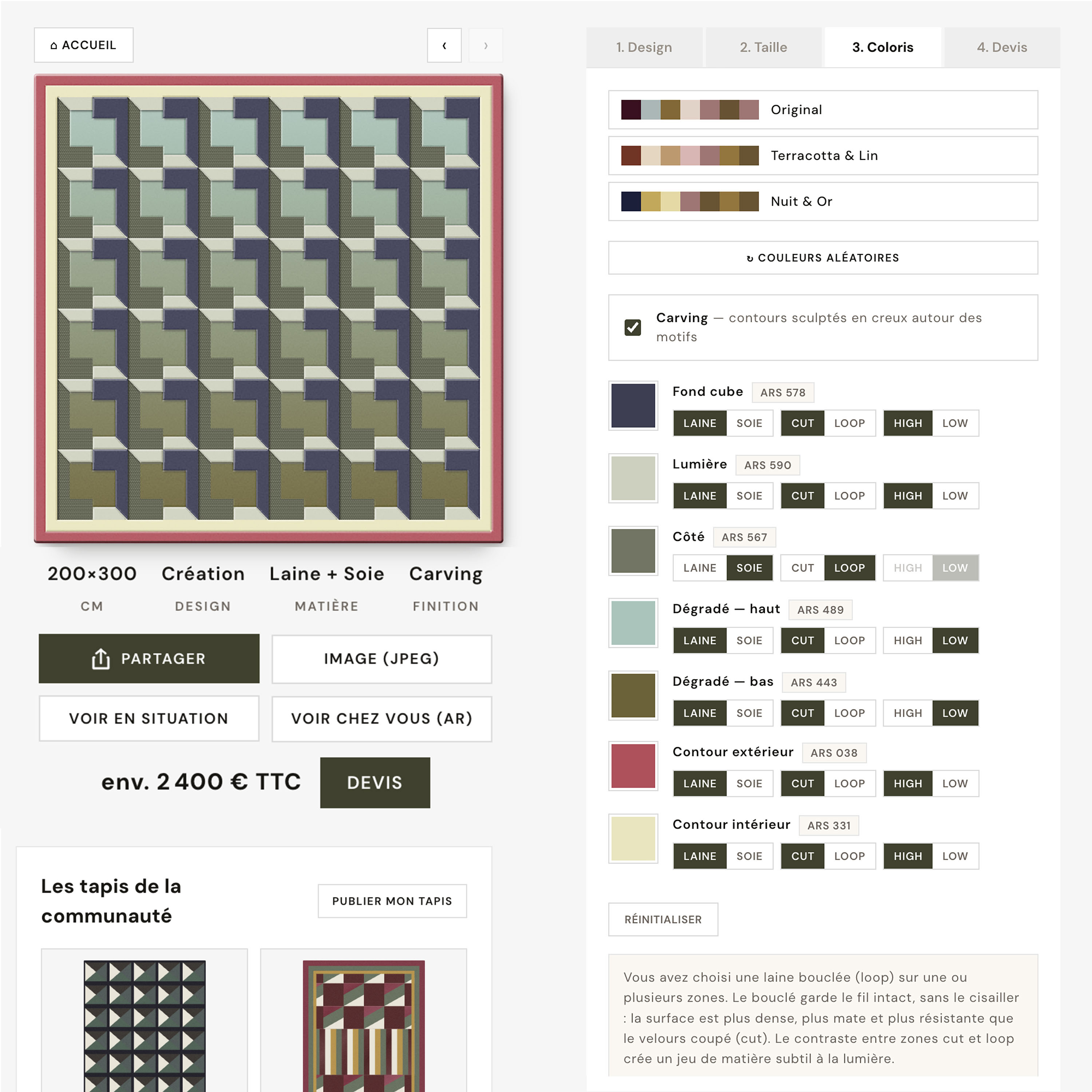
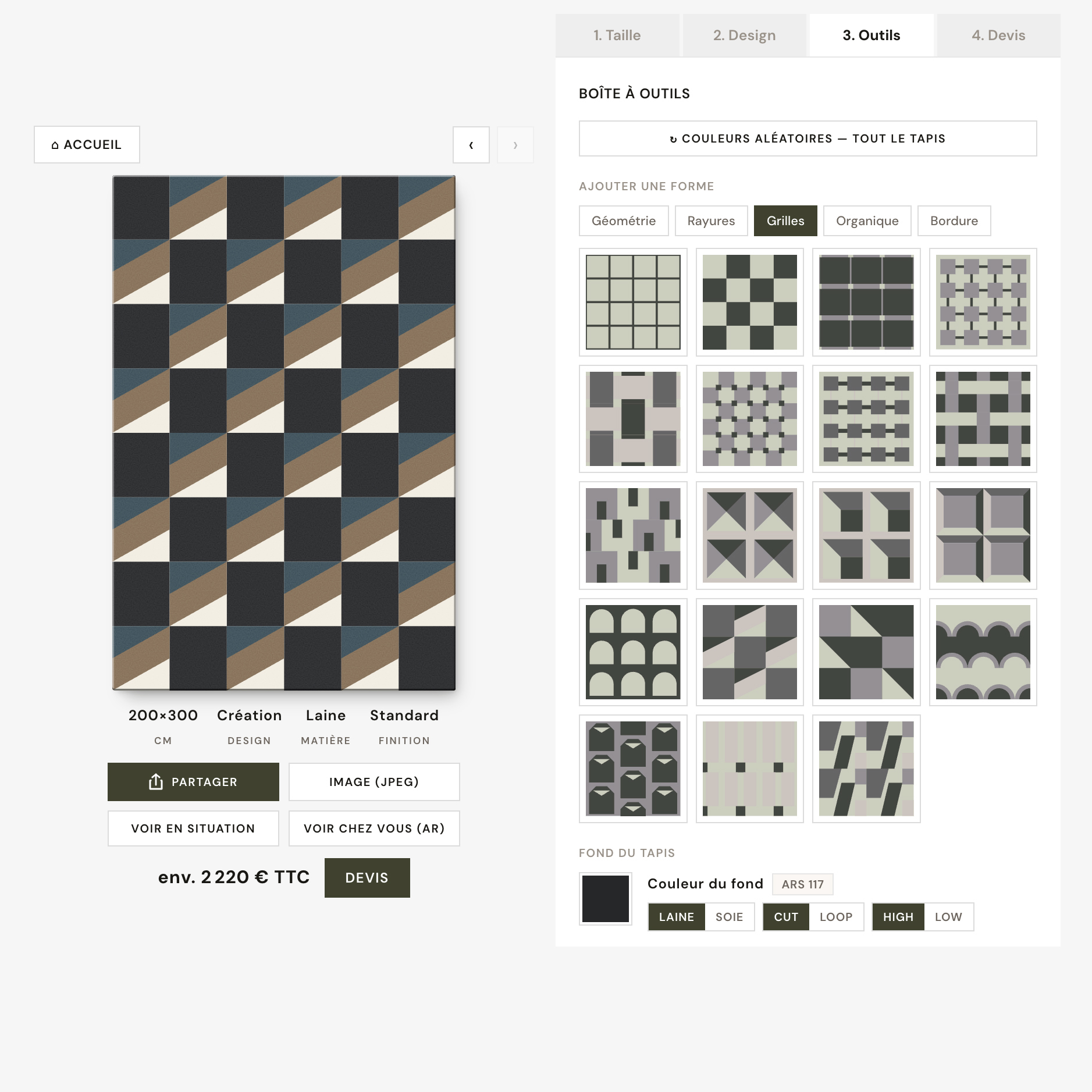
A first in the world of contemporary rugs: Studio Rugier invites you to compose your own piece online, with the precision of a workshop. It works as an open design space, where a catalogue would go no further than offering variants.
The tool brings a vision together with the craftsmanship of the house, from the first line to the hand-tufting in the Bhadohi workshops. You customise a design from the collection, import your own vector files, generate patterns from a toolkit, test more than a thousand complementary palettes or import the colours of a project in progress.
You visualise the rug in augmented reality, to scale, in the room it is meant for. The quotation goes out in one click and triggers production.
What the Studio makes possible
- Customise the collection designs
- Import your own vector designs
- Generate patterns with the toolkit
- Test more than 1,000 complementary palettes
- Import the colours of a project
- Visualise in augmented reality
- Save and download your designs
- Request a quotation in one click
Rémanence — Rugier & Not Minimalist
17 September 2026, Hôtel Pavillon Faubourg Saint-Germain, Paris 7th arrondissement. Rugier and Not Minimalist open Rémanence as the design season opens in Paris, from 10 to 19 September 2026, alongside the Maison&Objet fair.
The event is a chance to see the pieces at full scale, in a lived-in interior, in a domestic setting where a trade fair would impose the stand, and to meet the two founders.
Three sets occupy the venue: an Italian garden, a country garden and a grotto. The rugs lie on the floor, beneath the objects, in furnished rooms — Not Minimalist, who curates singular objects for hotels, restaurants and brands, signs the selection around them.
5 rue du Pré aux Clercs, 75007 Paris. Thursday 17 September, 10am to 10pm; cocktail from 7pm. Press are welcome all day without an appointment; a guided walkthrough of the three sets can be arranged with Pierre Jungers. Registration at rugiertextiles.com/pages/remanence.

Practical information
- Date
- Thursday, 17 September 2026
- Venue
- Hôtel Pavillon Faubourg Saint-Germain
- Address
- Hôtel Pavillon Faubourg Saint-Germain, 5 rue du Pré aux Clercs, 75007 Paris
- Opening hours
- Thursday 17 September 2026, 10am to 10pm. Cocktail from 7pm.
- Press access
- Press welcome all day, no appointment needed. Guided walkthrough of the three sets on request from Pierre Jungers.
- Part of
- As the design season opens in Paris, 10 to 19 September 2026
- Registration
- rugiertextiles.com/remanence
Prices, sizes
and press contact
Retail prices incl. VAT, by collection and size
- Collection
- 170 × 240
- 200 × 300
- 250 × 350
- Optical Palazzo
- 1,700 €
- 2,350 €
- 3,400 €
- Moire
- 1,700 €
- 2,450 €
- 3,500 €
- La Pintura
- 1,850 €
- 2,600 €
- 3,700 €
- Highland Grounds
- 1,750 €
- 2,500 €
- 3,600 €
- Rugier Special
- 1,700 €
- 2,350 €
- 3,400 €
Bespoke sizes available on request, subject to minimum dimensions and an extended lead time. Delivery within France included, quoted separately for international shipping.
5 weeks of production from order confirmation, then 1 to 2 weeks for delivery.
Sold direct on rugiertextiles.com. Trade accounts for interior architects, hotels and design studios.
High-resolution images of every model, portraits of the founders and workshop pictures available on request.
Pierre Jungers
pierre@rugiertextiles.com
+33 6 71 33 58 50
For interview requests, loans of pieces or shoots, both founders are available in Paris.
RUGIER SAS
34 rue Pierret
92200 Neuilly-sur-Seine
France
rugiertextiles.com
+33 6 71 33 58 50